Physics Background
Non-equilibrium quantum many-particle physics
Simulating the time evolution of strongly driven many-body quantum systems is challenging because behavior distinct from the equilibrium properties can emerge on vastly different timescales.
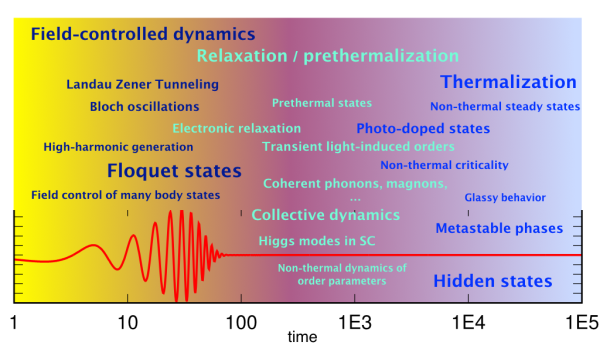
Fig. 1 Time scales for different light-induced phenomena in lattice systems.
Such simulations are relevant in a broad variety of contexts:
By driving condensed matter with tailored light one can engineer novel quantum phases. Light-induced superconductivity or Floquet states are among the tantalizing examples. See D. N. Basov, R. D. Averitt, and D. Hsieh, Towards properties on demand in quantum materials, Nature Materials 16, 1077 (2017).
Analog quantum simulation platforms allow exploration of genuine non-equilibrium phenomena, such as dynamics at the boundary between integrable and ergodic behavior.
Dissipative driven quantum systems are relevant for quantum transport and nanotechnology, including quantum computing architectures.
Time-resolved pump-probe spectroscopy reveals the interplay of quasiparticles and collective excitations on microscopic timescales. See Claudio Giannetti et al., Ultrafast optical spectroscopy of strongly correlated materials…, Advances in Physics 65, 58 (2016).
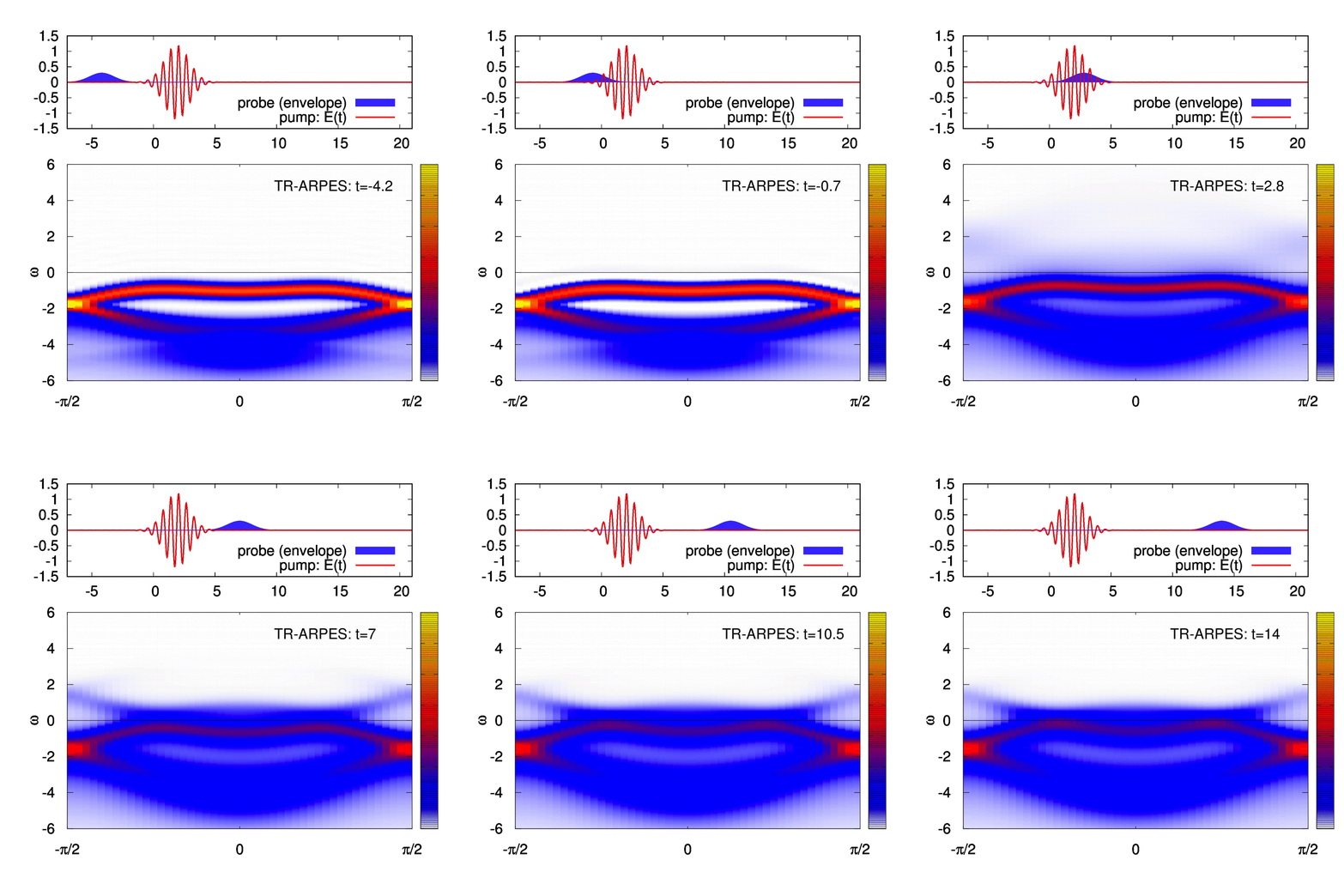
Fig. 2 Example: Simulated time- and angular-resolved photoemission spectrum (tr-ARPES)
of an excitonic insulator. The movie (GIF) illustrates how tr-ARPES reveals
electronic structure out of equilibrium, including filling, broadening,
internal relaxation, gap closing, and thermalization.
Time-dependent GW simulations performed using the NESSi library.
See Denis Golež, Philipp Werner, and Martin Eckstein,
Photo-induced gap closure in an excitonic insulator, Phys. Rev. B 94, 035121 (2016).
Keldysh Formalism and Nonequilibrium Green’s Functions
Non-equilibrium Green’s functions (NEGF)
Field-theoretical approaches based on Green’s functions provide a versatile framework for deriving systematic approximations to quantum many-particle systems. Green’s functions measure spectra and occupations of quasiparticles and therefore directly give spectroscopic quantities like tr-ARPES.
This complements exact many-body methods whose Hilbert-space scaling is exponential.
The NEGF approach, pioneered by Keldysh, Kadanoff and Baym, extends equilibrium many-body tools (diagrams, functional integrals) to nonequilibrium phenomena.
For basic introductions, see:
Kamenev, Field Theory of Non-equilibrium Systems, CUP (2011).
G. Stefanucci and R. van Leeuwen, Nonequilibrium Many-Body Theory of Quantum Systems, CUP (2013).
H. Haug and A.-P. Jauho, Quantum Kinetics in Transport and Optics of Semiconductors, Springer (2008).
The Keldysh formalism underlies the quantum Boltzmann equation,
fluctuation–dissipation relations, and numerical two-time Green’s function
methods. This is where NESSi enters.
Kadanoff–Baym (KB) equations
Very schematically, a non-equilibrium propagator \(G_{ij}(t,t')\) describes a two-time correlation between excitations. Its equation of motion is
Here \(H_{mf}\) is an effective one-body Hamiltonian including mean-fields, and \(\Sigma(t,t')\) is the self-energy, describing interaction effects and coupling to environments. Equation (1) is non-Markovian.
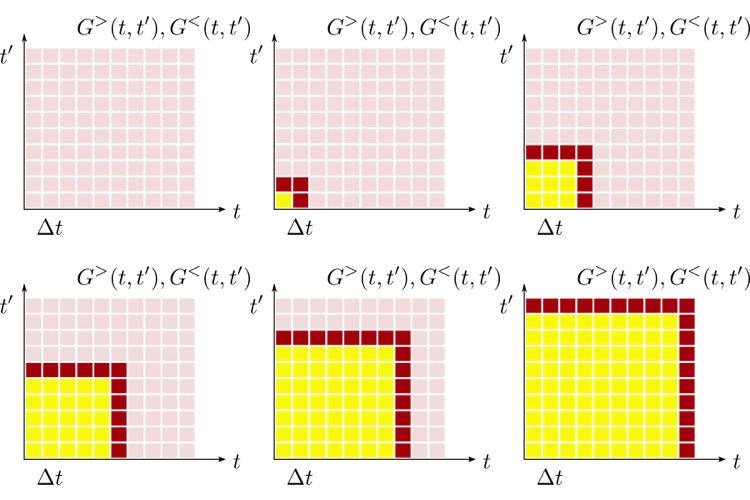
Fig. 3 Causal propagation of a two-time NEGF: computing \(G(t,t')\) at the red point requires knowledge of all previous Green’s functions and self-energies (yellow region).
NESSi implements these equations using the formulation successful in
nonequilibrium DMFT (see Aoki et al., Rev. Mod. Phys., 2014; Eckstein 2010).
Mathematical formulation
The Keldysh contour
Non-equilibrium many-body theory is naturally formulated on a time contour.
The L-shaped contour \(\mathcal{C}\) represents a system that begins in a thermal state with density matrix \(\rho = e^{-\beta H(0_-)}/Z\).
libcntris tailored to this contour.Non-equilibrium steady states (NESS) typically depend only on relative time, suggesting a contour pushed to \(t=-\infty\).
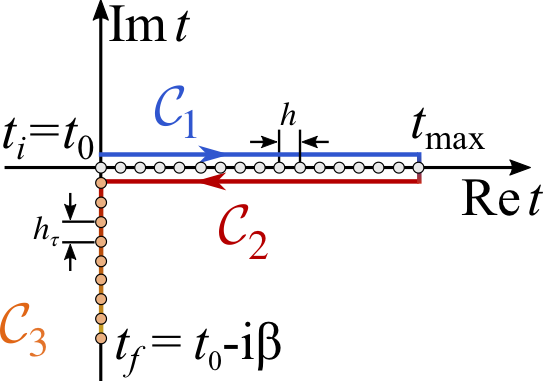
Fig. 4 L-shaped Kadanoff–Baym contour with real-time and Matsubara branches, discretized for numerical evaluation.
Contour-ordered Green’s functions
All relevant expectation values appear as contour-ordered objects:
where \(\xi=+1\) for bosons and \(-1\) for fermions.
The basic two-time correlator is
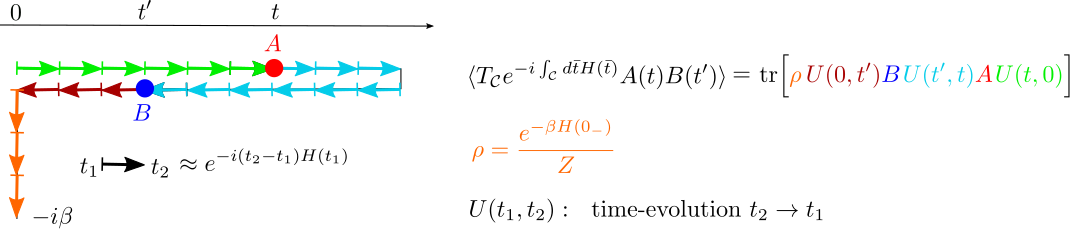
Fig. 5 Unfolding contour-ordered expectation values into real-time correlators when \(\mathcal{S}\) corresponds to Hamiltonian evolution.
Important Keldysh components
Lesser: \(C^<(t,t') = -i\xi \langle B(t') A(t) \rangle\)
Greater: \(C^>(t,t') = -i \langle A(t) B(t') \rangle\)
Retarded: \(C^R(t,t') = -i \theta(t-t') [A(t),B(t')]_\xi\)
Matsubara: imaginary-time component
In libcntr they are stored as
\(\{C^<, C^R, C^\rceil, C^M\}\)
on the contour \(\mathcal{C}[h,N_t,h_\tau,N_\tau]\).
Numerical solution and accuracy
Dyson equations are reduced to Volterra integral equations and solved using Gregory quadrature rules (Brunner & van Houven, The numerical solution of Volterra equations, North Holland, 1986).
A rule of degree \(k\) approximates
The numerical error scales as \(\mathcal{O}(N^{-(k+2)})\).
Order \(k=0\) corresponds to trapezoidal integration with error \(\mathcal{O}(N^{-2})\).
Previous use of NESSi
Before public release (2019), NESSi was used extensively in nonequilibrium
DMFT studies of correlated systems. Over 60 publications rely on it.
Thermalization of a pump-excited Mott insulator
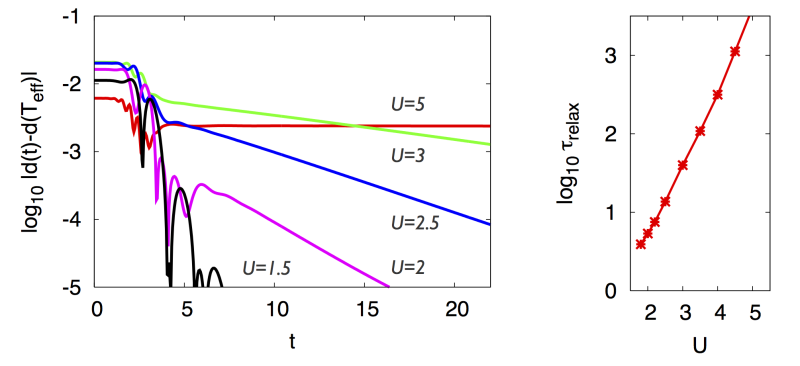
Fig. 6 Dynamics of doublon density and relaxation times as function of \(U\). From Eckstein & Werner, Phys. Rev. B 84, 035122 (2011).
Doublon relaxation in photo-excited 1T-TaS₂
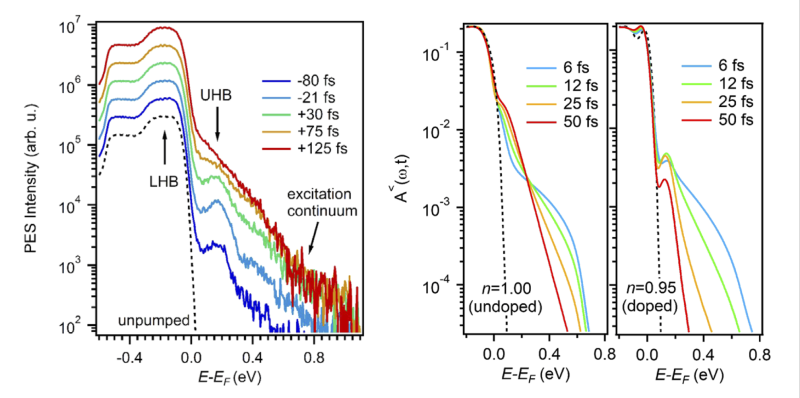
Fig. 7 Comparison between experiment and DMFT simulations for doublon dynamics. From Ligges et al., PRL 120, 166401 (2018).
Benchmarking quantum simulators
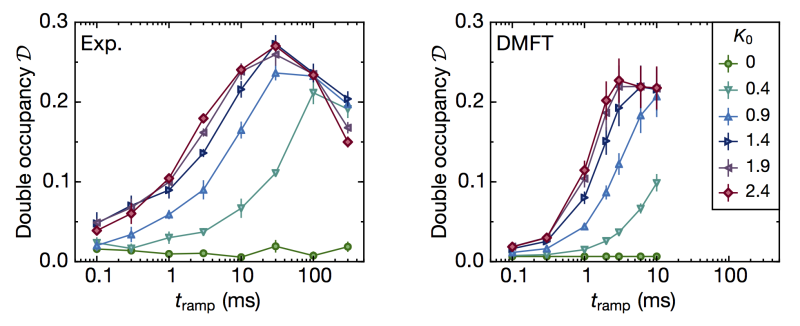
Fig. 8 Doublon production in driven cold atom systems vs. nonequilibrium DMFT. From K. Sandholzer et al., arXiv:1811.12826.