Test of accuracy of Dyson solver: equilibrium
Synopsis
This test program tests the accuracy of the solution of the Dyson equation on the Matsubara axis (see Dyson Equation) in the context of a numerically exactly solvable downfolding problem. The scaling of the averaged error can be obtained for different values of SolveOrder.
Details and implementation
We consider a \(2\times 2\) matrix-valued time-independent Hamiltonian
The corresponding numerically exact Green’s function \(G(t,t^\prime)\) (assuming fermions) is computed using the routine cntr::green_from_H. One can also calculate the (1,1) component of this Green’s function by downfolding. In this procedure, we solve
with the embedding self-energy \(\Sigma(t,t^\prime) = |\lambda|^2 g_2(t,t^\prime)\). Here, \(g_2(t,t^\prime)\) is the free Green’s function with respect to
The solution of the downfolding Dyson equation (40) must be identical to the \((1,1)\) matrix element of \(G\): \(G_{1,1}(t,t^\prime)=g_1(t,t^\prime)\).
The test program for the equilibrium problem solves Eq. (40) for the Matsubara component only (tstp=-1), and computes the differences between the exact and approximate solution as
Here, \(\Delta[A,B]\) denotes the norm difference (see Comparing Green’s functions) at tstp=-1.
In the test program programs/test_equilibrium.cpp, we have implemented this task in a straightforward way.
The code is a direct extension of a generic libcntr-based program (see Creating a Custom Program). The parameters of the Hamiltonian are defined as constants. In particular, we fix \(\epsilon_1=-1\), \(\epsilon_2=1\), \(\lambda=0.5\). The chemical potential is set to \(\mu=0\) and the inverse temperature fixed to \(\beta=20\). After reading the input from file (see Creating and Passing Input Files), we define the \(2\times 2\) Hamiltonian (39) as an eigen3 complex matrix:
cdmatrix eps_2x2(2,2);
eps_2x2(0,0) = eps1;
eps_2x2(1,1) = eps2;
eps_2x2(0,1) = I*lam;
eps_2x2(1,0) = -I*lam;
The \(1\times 1\) Hamiltonian representing \(\epsilon_1\) is constructed as
CFUNC eps_11_func(-1,1);
eps_11_func.set_constant(eps1*MatrixXcd::Identity(1,1));
Here, eps_11_func is a contour function entering the solvers below. Note the first argument in the constructor of CFUNC: the number of real-time points \(N_t\) is set to -1. In this case, only the Matsubara part is addressed. Its value is fixed to the constant \(1\times 1\) matrix by the last line. With the Hamiltonians defined, we can initialize and construct the free \(2\times 2\) exact Green’s function by
GREEN G2x2(-1,Ntau,2,FERMION);
cntr::green_from_H(G2x2,mu,eps_2x2,beta,h);
The time step h is a dummy argument here, as the real-time components are not addressed. From the exact Green’s function, we extract the submatrix \(G_{1,1}\) by
GREEN G_exact(-1,Ntau,1,FERMION);
G_exact.set_matrixelement(-1,0,0,G2x2);
Finally, we define the embedding self-energy by
GREEN Sigma(-1,Ntau,1,FERMION);
cdmatrix eps_22=eps2*MatrixXcd::Identity(1,1);
cntr::green_from_H(Sigma, mu, eps_22, beta, h);
Sigma.smul(-1,lam*lam);
The last line performs the multiplication of \(\mathcal{T}[\Sigma]_{-1}\) with the scalar \(\lambda^2\). After initializing the approximate Green’s function G_approx, we can solve the Matsubara Dyson equation and compute the average error:
cntr::dyson_mat(G_approx,  mu, eps_11_func, Sigma, beta, SolveOrder, CNTR_MAT_FOURIER);
err_fourier = cntr::distance_norm2(-1,G_exact,G_approx) / Ntau;

cntr::dyson_mat(G_approx,  mu, eps_11_func, Sigma, beta, SolveOrder, CNTR_MAT_FIXPOINT);
err_fixpoint = cntr::distance_norm2(-1,G_exact,G_approx) / Ntau;
The relevant source files are the following:
|
source code of program |
|
python driver script |
Running the program
The program is run by
./exe/test_equilibrium.x inp/input_equilibrium.inp
Here, inp/input_equilibrium.inp is a libcntr input file with the format described in Creating and Passing Input Files. It contains the variables
|
Number of points on the Matsubara axis |
|
Solution order |
The output is appended to the file out/test_nonequilibrium.dat in two columns, the error of the Fourier method and the Newton iteration. For instance, the input Ntau=100 and SolveOrder=2 yields the output
$ cat out/test_equilibrium.dat
1.9385e-05 7.0587e-06
We provide a useful python driver script, which runs test_equilibrium.x for a range of values of Ntau.
It uses the python module ReadCNTR (see Python Tools). It can be launched via
python utils/test_equilibrium.py 2
The last argument is SolveOrder=1,...,5. After running the calculation, the logarithm of the error is plotted against \(\log(N_\tau)\), and the scaling of the error is extracted by a linear regression.
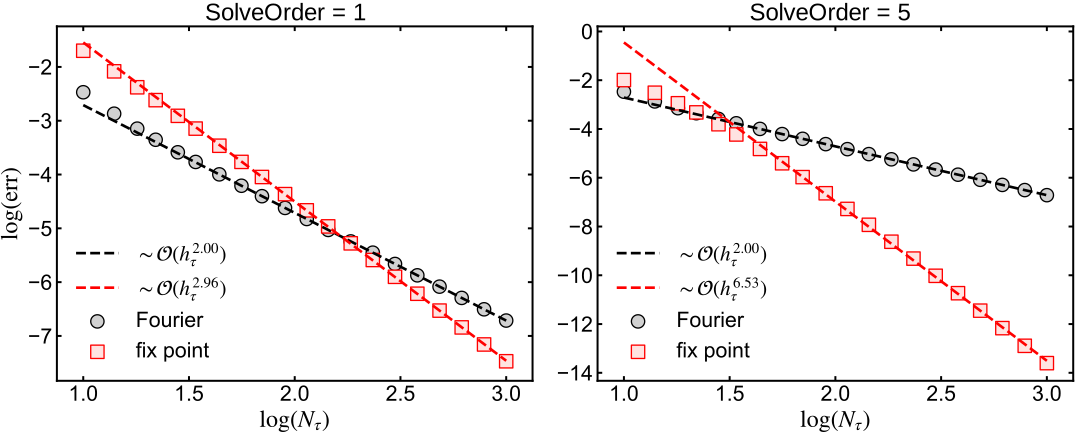
Fig. 9 Equilibrium scaling: Average error of solving the Matsubara Dyson equation with the Fourier method (circles) and the fix-point iteration (squares) for SolveOrder=1 (left) and SolveOrder=5 (right panel).
Test of accuracy of Dyson solver: nonequilibrium
Synopsis
This test program tests — similar to the example Test of accuracy of Dyson solver: equilibrium — the accuracy of the solution of the Dyson equation (see Dyson Equation) and Volterra integral equation (see VIE2) for the numerically exactly solvable downfolding problem. The scaling of the averaged error can be obtained for different values of SolveOrder.
Details and Implementation
In this example, we solve the Dyson equation (40) on the whole Kadanoff-Baym contour \(\mathcal{C}\). Equivalently, one can also solve the Dyson equation in integral form
where \(F= -\Sigma\ast g_1^{(0)}\) and \(F^\ddagger=-g_1^{(0)}\ast \Sigma\). The free Green’s function \(g_1^{(0)}(t,t^\prime)\) is known analytically and computed by calling the routine cntr::green_from_H (see Green’s function for a constant or time-dependent Hamiltonian).
The structure of the test program is analogous to the equilibrium case. After reading the parameters from the input file and fixing h=Tmax/Nt, the embedding self-energy is constructed on the whole contour by
cntr::green_from_H(Sigma, mu, eps_22, beta, h);

for(tstp=-1; tstp<=Nt; tstp++) {
    Sigma.smul(tstp,lam*lam);
}
Solving a generic Dyson equation is accomplished by three steps (see Dyson Equation):
solve the equilibrium problem by solving the corresponding Matsubara Dyson equation,
compute the NEGFs for time steps
n=0,...,SolveOrderby using the starting algorithm (bootstrapping), andperform the time stepping for
n=SolveOrder+1,...,Nt.
For Eq. (40), this task is accomplished by
GREEN G_approx(Nt, Ntau, 1, FERMION);

// equilibrium
cntr::dyson_mat(G_approx, mu, eps_11_func, Sigma, beta, SolveOrder);

// start
cntr::dyson_start(G_approx, mu, eps_11_func, Sigma, beta, h, SolveOrder);

// time stepping
for (tstp=SolverOrder+1; tstp<=Nt; tstp++) {
    cntr::dyson_timestep(tstp, G_approx, mu, eps_11_func, Sigma, beta, h, SolveOrder);
}
The deviation of the nonequilibrium Keldysh components from the exact solution is calculated using the Euclidean norm distance (see Comparing Green’s functions). Here, we define the average error by
err_dyson=0.0;
for(tstp=0; tstp<=Nt; tstp++){
    err_dyson += 2.0 * cntr::distance_norm2_les(tstp, G_exact, G_approx) / (Nt*Nt);
    err_dyson += 2.0 * cntr::distance_norm2_ret(tstp, G_exact, G_approx) / (Nt*Nt);
    err_dyson += cntr::distance_norm2_tv(tstp, G_exact, G_approx) / (Nt*Ntau);
}
Note that we compare here individual components of the Green’s functions (G_exact and G_approx) by using cntr::distance_norm2_XXX. One may use also a single cntr::distance_norm2 routine.
Solving the integral form (42) by using vie2 proceeds in three analogous steps, as for Dyson (see Non-singular VIE2). The following source code demonstrates the implementation:
// noninteracting 1x1 Greens function (Sigma=0)
GREEN G0(Nt,Ntau,1,FERMION);
cdmatrix eps_11=eps1*MatrixXcd::Identity(1,1);
cntr::green_from_H(G0, mu, eps_11, beta, h);

GREEN G_approx(Nt,Ntau,1,FERMION);
GREEN F(Nt,Ntau,1,FERMION);
GREEN Fcc(Nt,Ntau,1,FERMION);

// equilibrium
GenKernel(-1, G0, Sigma, F, Fcc, beta, h, SolveOrder);
cntr::vie2_mat(G_approx, F, Fcc, G0, beta, SolveOrder);

// start
for(tstp=0; tstp <= SolveOrder; tstp++){
    GenKernel(tstp, G0, Sigma, F, Fcc, beta, h, SolveOrder);
}
cntr::vie2_start(G_approx, F, Fcc, G0, beta, h, SolveOrder);

// time stepping
for (tstp=SolveOrder+1; tstp<=Nt; tstp++) {
    GenKernel(tstp, G0, Sigma, F, Fcc, beta, h, SolveOrder);
    cntr::vie2_timestep(tstp, G_approx, F, Fcc, G0, beta, h, SolveOrder);
}
For convenience, we have defined the routine GenKernel which calculates the convolution kernels \(F\) and \(F^\ddagger\):
void GenKernel(int tstp, GREEN &G0, GREEN &Sigma, GREEN &F, GREEN &Fcc, const double beta, const double h, const int SolveOrder){
    cntr::convolution_timestep(tstp, F, G0, Sigma, beta, h, SolveOrder);
    cntr::convolution_timestep(tstp, Fcc, Sigma, G0, beta, h, SolveOrder);
    F.smul(tstp,-1);
    Fcc.smul(tstp,-1);
}
The error is computed in the same way as above:
err_dyson=0.0;
for(tstp=0; tstp<=Nt; tstp++){
    err_vie2 += 2.0 * cntr::distance_norm2_les(tstp, G_exact, G_approx) / (Nt*Nt);
    err_vie2 += 2.0 * cntr::distance_norm2_ret(tstp, G_exact, G_approx) / (Nt*Nt);
    err_vie2 += cntr::distance_norm2_tv(tstp, G_exact, G_approx) / (Nt*Ntau);
}
The implementation of this example can be found here:
|
source code of program |
|
python driver script |
Running the program
The program is run by
./exe/test_nonequilibrium.x inp/input_nonequilibrium.inp
As above, inp/input_nonequilibrium.inp is an input file formatted as explained in Creating and Passing Input Files, providing the following input variables:
|
Number of points on the real-time axis |
|
Number of points on the Matsubara axis |
|
Propagation time, defines the time step interval by |
|
Solution order |
The output is appended to the file out/test_nonequilibrium.dat. The two columns contain the error of solving the problem as Dyson equation and as Volterra integral equation, respectively. As an example, setting Nt=100, Ntau=200, Tmax=5.0 and SolveOrder=1 yields
$ cat out/test_nonequilibrium.dat
0.0081178 4.5843e-05
The python driver script utils/test_nonequilibrium.py provides a simple interface to run the test program, which performs calculations for a series of values of Nt. Simply run
python utils/test_nonequilibrium.py k
where k=1,...,5 stands for the SolveOrder input.
After running the calculations, the logarithm of the error is plotted against \(\log(N_t)\). The scaling of the error is extracted by a linear regression of the logarithmic errors. The plots produced by utils/test_nonequilibrium.py are shown in Fig. 10. As confirmed in Fig. 10, the average error scales as \(\mathcal{O}(h^{k+1})\) for dyson, while solving the problem using vie2 yields a \(\mathcal{O}(h^{k+2})\) scaling (\(k\) stands for SolveOrder.)
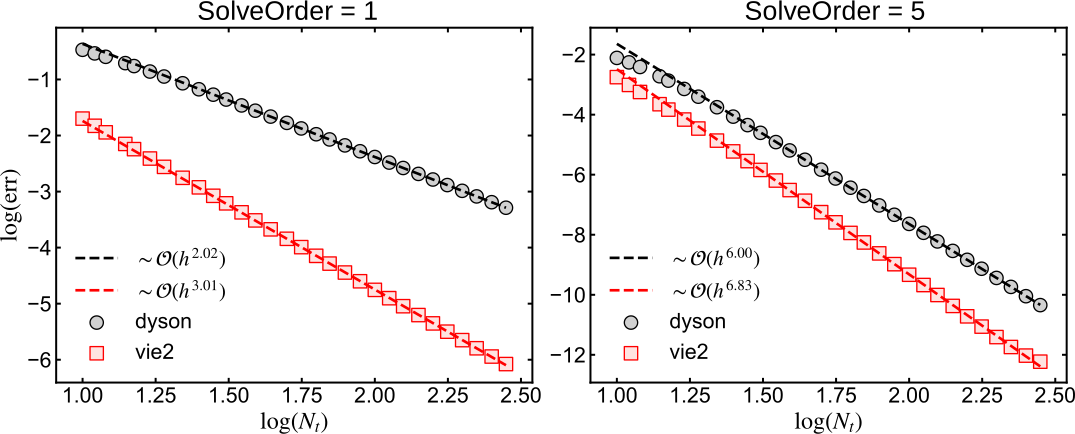
Fig. 10 Nonequilibrium scaling: Average error for the integro-differential (Dyson) and integral (VIE2) formulation of the downfolding problem for SolveOrder=1 (left) and SolveOrder=5 (right panel). We adopt the same parameters as for the equilibrium case but fix Ntau=800.